
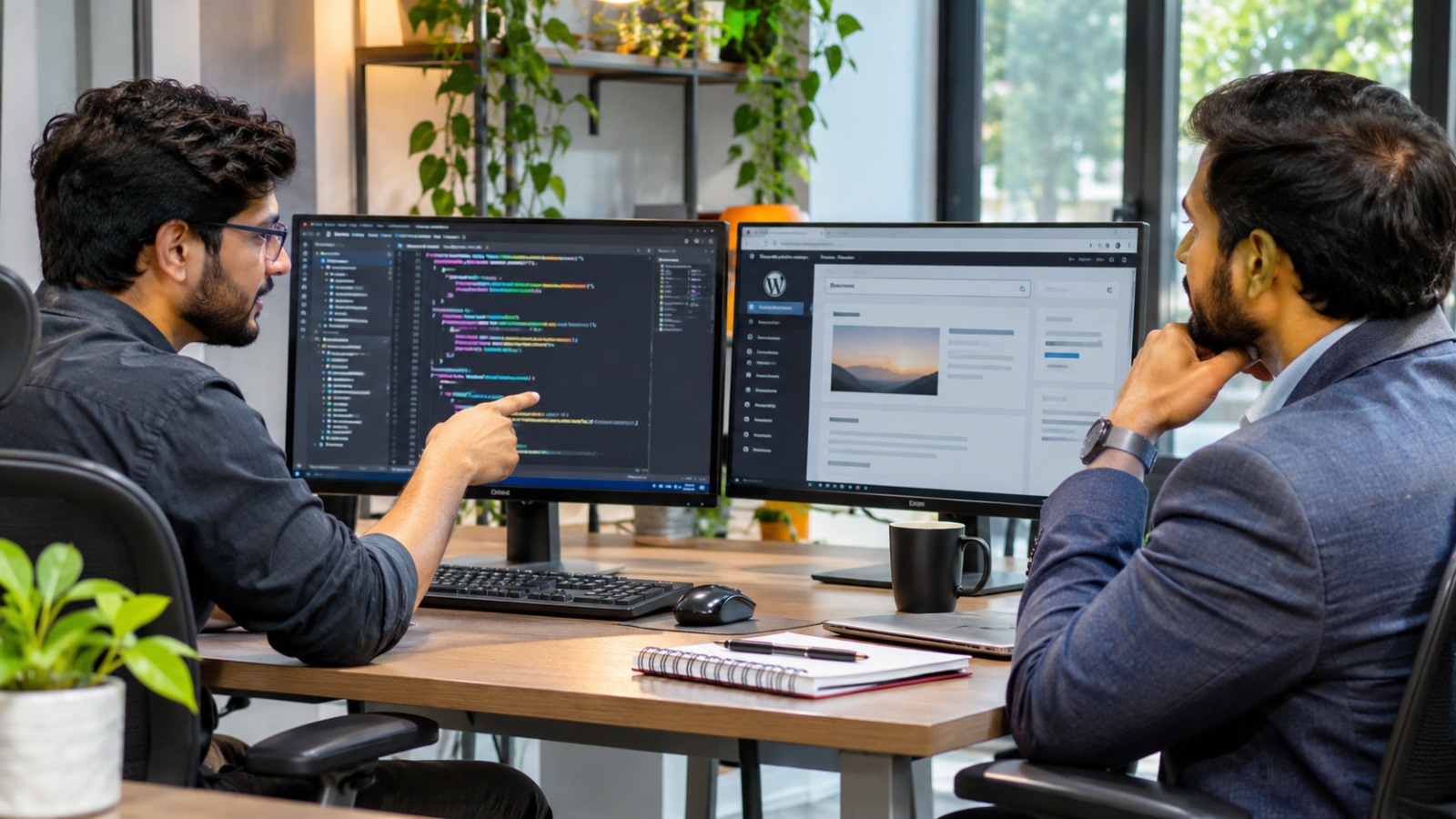
A business owner planning a new website usually hears two suggestions: “Build it on WordPress” and “Get a custom website developed.” Both can be sensible. The difficult part is knowing which one makes sense for your particular business, budget and future plans.
The decision matters because a website is not something you want to rebuild every few months. It should support today’s requirements without becoming a burden when your company expands. Before choosing a platform, it helps to understand what you are actually paying for.
What is a WordPress website?
WordPress is an open-source content management system, or CMS. In simple terms, it gives a business an administrative dashboard to add pages, publish articles, upload photographs and make routine content changes without editing the underlying code.
You can start with an existing theme, commission a custom theme, or extend the site through plugins and custom code. That flexibility makes WordPress useful for many company websites, professional portfolios, educational sites and online stores.
A WordPress website does not have to look like a template. With careful design and development, it can reflect a company’s brand very closely. The difference lies in how the system is managed and extended, not whether the finished website looks professional.
What does custom website development mean?
A custom website is developed around specific requirements rather than starting with a general-purpose CMS as the central foundation. Developers may build the interface, backend, database and integrations to match particular workflows.
Consider a clinic that needs patient registrations, appointment rules, doctor dashboards, reporting and role-based access. Some of this might be possible through WordPress, but if the workflow is unusual or complex, a purpose-built web application may be easier to control over time.
Custom development is not automatically superior. It introduces its own responsibilities, including documentation, testing, future updates and dependence on a capable development team.
The biggest differences for business owners
- Initial cost and project scope
For a conventional company website with service pages, a blog and contact forms, WordPress will often be quicker and less expensive to launch. It provides established publishing features from the beginning.
Custom development usually needs more planning and engineering before the site is ready. That extra investment may be justified when the website handles complicated business logic or integrations that are hard to achieve cleanly with off-the-shelf tools.
Ask for an itemized project scope instead of comparing quotations on price alone. Hosting, content entry, training, maintenance and third-party subscriptions can all affect the total cost.
- Everyday content updates
If your marketing team regularly publishes blogs, edits service descriptions or creates landing pages, WordPress is particularly convenient. Non-technical staff can be trained to handle common updates.
A custom platform can provide the same convenience, but someone must build a suitable content-editing interface. Without that, ordinary changes may require developer assistance.
- Unique features and integrations
WordPress can do much more than publish blog posts. Plugins and custom development can support online bookings, membership areas, product catalogues and various integrations.
However, plugins should not be treated as a shortcut for every requirement. Too many overlapping extensions may complicate maintenance or create compatibility issues. For a business with unique approval steps, complex data processing or operational dashboards, a custom application may offer a cleaner architecture
- Website speed and performance
Neither option is automatically faster. A poorly built custom website can be slow, and a carefully optimized WordPress site can perform very well. Performance depends on hosting, image sizes, scripts, database queries, caching and the quality of development. It is more useful to ask a development company how performance will be tested than to assume one technology guarantees good speed.
- Security and ongoing maintenance
WordPress requires updates to its core software, themes and plugins. Sites also need backups, access controls and security monitoring. Ignoring maintenance can expose a business to avoidable risks.
Custom websites require security work too. Developers must maintain dependencies, fix vulnerabilities, protect data and test changes. Custom does not mean maintenance-free.
For either approach, confirm who will be responsible for updates, backups, incident response and restoring the website if something goes wrong.
Which option is better for SEO?
You can build a search-friendly website with either WordPress or custom development. Search engines care about useful content, accessible pages, technical quality and signals that help them understand the site.
WordPress makes publishing articles, editing page titles and managing basic site structure relatively straightforward. A custom website can achieve equivalent results when SEO requirements are included in development from the beginning.
The real problems arise when a website launches without clean page URLs, sensible headings, internal links, crawlable content or a plan for updating information. These are implementation decisions rather than unavoidable limitations of a platform.
Three real-world decision examples
A local accounting firm: It needs service pages, team profiles, articles and a consultation form. A well-designed WordPress website will usually cover those needs without unnecessary complexity.
A growing fashion retailer: It needs a product catalogue, order management and payment integration. WordPress with WooCommerce could be a practical option, depending on inventory size and operational needs. More specialized commerce requirements might justify another platform.
A research organization: It needs participant registration, data collection forms, permission levels and customized reports. Here the conversation should begin with workflows, privacy and system architecture, not with selecting a theme. A custom application may be appropriate.
These examples show why the right answer depends on what the website must actually do.
Questions to ask before hiring a developer
Before signing a project agreement, discuss these points: Who will update website content? Do you expect online payments or user accounts? Which external systems must connect? What should happen as traffic grows? Who owns the code, domain and hosting? What ongoing maintenance is included?
It is also worth requesting a demonstration of how staff will complete common tasks. An impressive homepage means little if the day-to-day administration is frustrating.
Frequently asked questions
Is WordPress suitable for a serious business?
Yes. WordPress can support professional websites and can be customized extensively. Suitability depends on the features required and the way the site is built and maintained.
Is a custom website always more expensive?
Not in every situation, but custom development typically involves more initial engineering for comparable standard features. The true cost depends on requirements and long-term maintenance.
Can I move from WordPress to a custom website later?
Usually yes, although content, URLs, media and functionality must be migrated carefully. Planning redirects and protecting existing search visibility are important parts of the process.
Which option is best for a startup?
A startup with straightforward marketing needs can often begin with WordPress. If the website itself is the product, with unusual user workflows, a custom solution may be more appropriate.
Final thoughts
Choosing between WordPress and a custom website should not become a contest over which technology sounds more advanced. The best platform is the one that meets your requirements, fits your resources and remains manageable as your business grows.
At Aneek Tech, we work on WordPress websites, business websites and custom web applications. Our approach begins with understanding your goals and recommending the development route that serves them rather than adding features you do not need.
If you are planning a new website or wondering whether your current platform is holding you back, explore our Web Development Services or contact Aneek Tech to discuss your project.